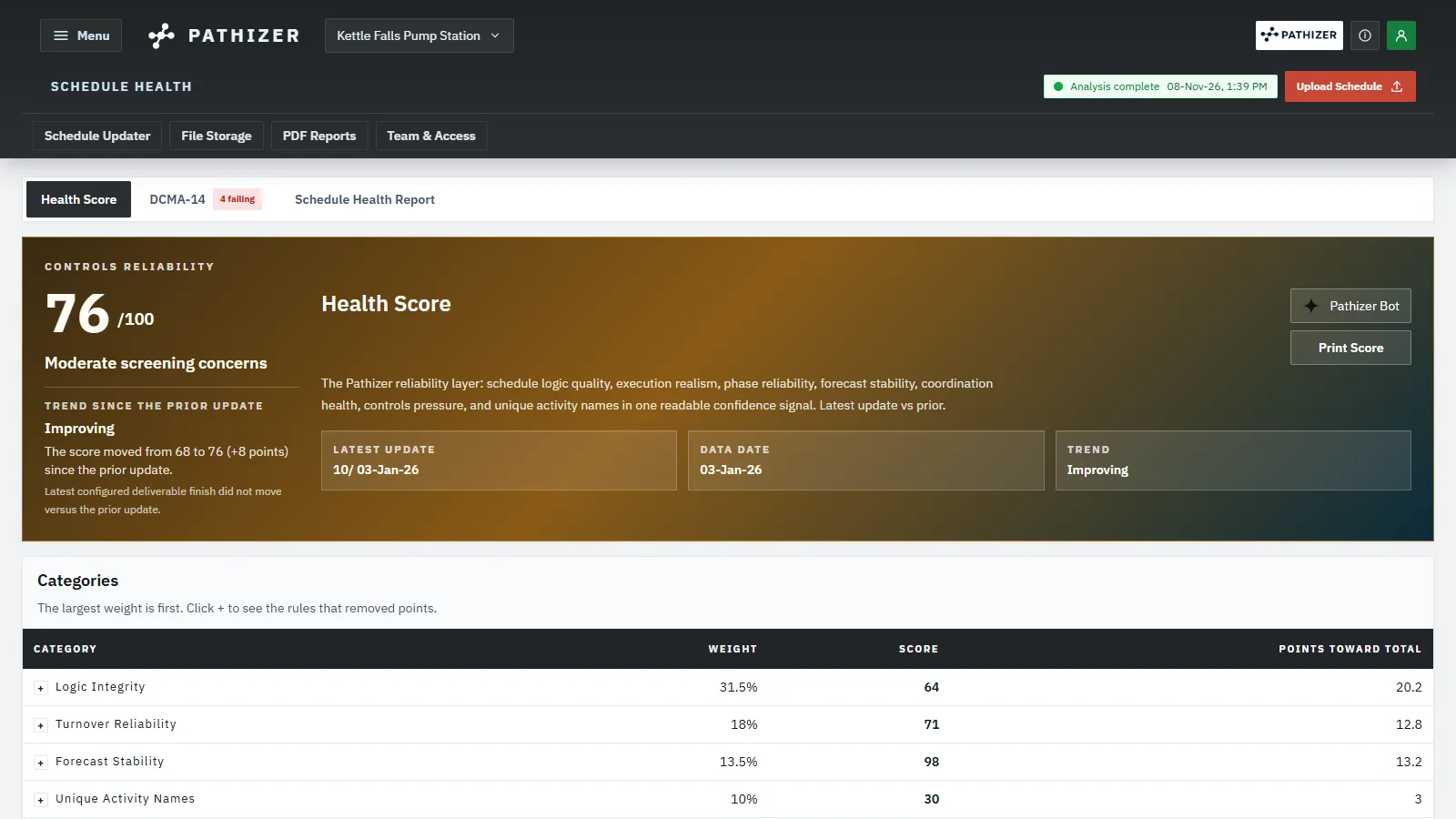
Health Score

Health Score and DCMA 14-Point Check

Run the DCMA 14-point checks each time an update is analyzed, from missing logic and hard constraints to CPLI and BEI, and score the schedule out of 100.

Example: a 200-activity update carrying 14 hard constraints is at 7 percent against the DCMA threshold of 5 percent, and the check lists the 14 activities so the scheduler can clear them before submission. (Illustrative figures.)

The DCMA 14-point assessment in brief

The Defense Contract Management Agency published fourteen checks for judging whether an integrated master schedule is built well enough to rely on. They are widely used well beyond defense work because each one is simple to state and to count. The targets Pathizer applies are the published ones:

  • Logic: 5% or fewer incomplete tasks missing a predecessor or successor. Leads: none. Lags: 5% or fewer relationships. Relationship types: 90% or more Finish to Start.
  • Hard constraints: 5% or fewer. High float and high duration: 5% or fewer tasks over 44 working days. Negative float: none. Invalid dates: none.
  • Resources: 95% or more of incomplete tasks carry a resource or cost, assessed only on a loaded schedule. Missed tasks: 5% or fewer.
  • Critical path test: a delay injected on the critical path must move the finish. CPLI and BEI: 0.95 or better.

How Pathizer runs the checks

Each time an update is analyzed, the checks run on it as the latest update, deterministically, and each one lists the activities or relationships behind its number so they can be fixed before the next submission. The checks are not kept for earlier updates; the 0 to 100 score and its categories are. Missed Tasks and BEI use the project's earliest update as the baseline and are marked not assessed when only one update exists. The Critical Path Test reschedules the update's own XER with its calendars and constraints; when that network is not available, a logic-only pass stands in and says so.

On top of the checks sits the Health Score, a weighted 0 to 100 reading across seven categories: logic integrity (31.5%), turnover reliability (18%), forecast stability (13.5%), unique activity names (10%), execution reliability (9%), coordination health (9%) and operational pressure (9%). A category with no input is left out and the weights of the rest are rescaled, and the effective weights are shown with the score.

Reading the result

The score carries a plain label rather than a grade: 90 and above reads as few flagged schedule conditions, and the labels step down through some conditions to review, moderate and elevated screening concerns, to extensive screening concerns below 60. The trend across the update history matters more than any single month, which is why the score is kept per update.

Who It Is For

Knowing whether a schedule is built well enough to rely on

SchedulersProject controls managersOwners reviewing a contractor schedule

What Pathizer Does

A 0-100 operational reliability score with category sub-scores

DCMA 14-point checkpoint results for the latest analyzed update

Findings that name the activities behind each result

Score trend across the update history

Practical Outputs

What you get.

A score for every update, and the checks behind the latest one

Findings you can act on before the next submission

A trend showing whether schedule quality is improving

Related Workflows

Related pages.

FAQ

Run it on your own schedules with the 60-Day Pilot. It covers your whole organization for 60 days and needs no card.

Start a 60-Day Pilot

Each finding traces back to the schedule export it came from.

When the update history cannot tie a day of movement to a party, Pathizer leaves that day unattributed. It does not split the day pro rata or round it into the largest share.