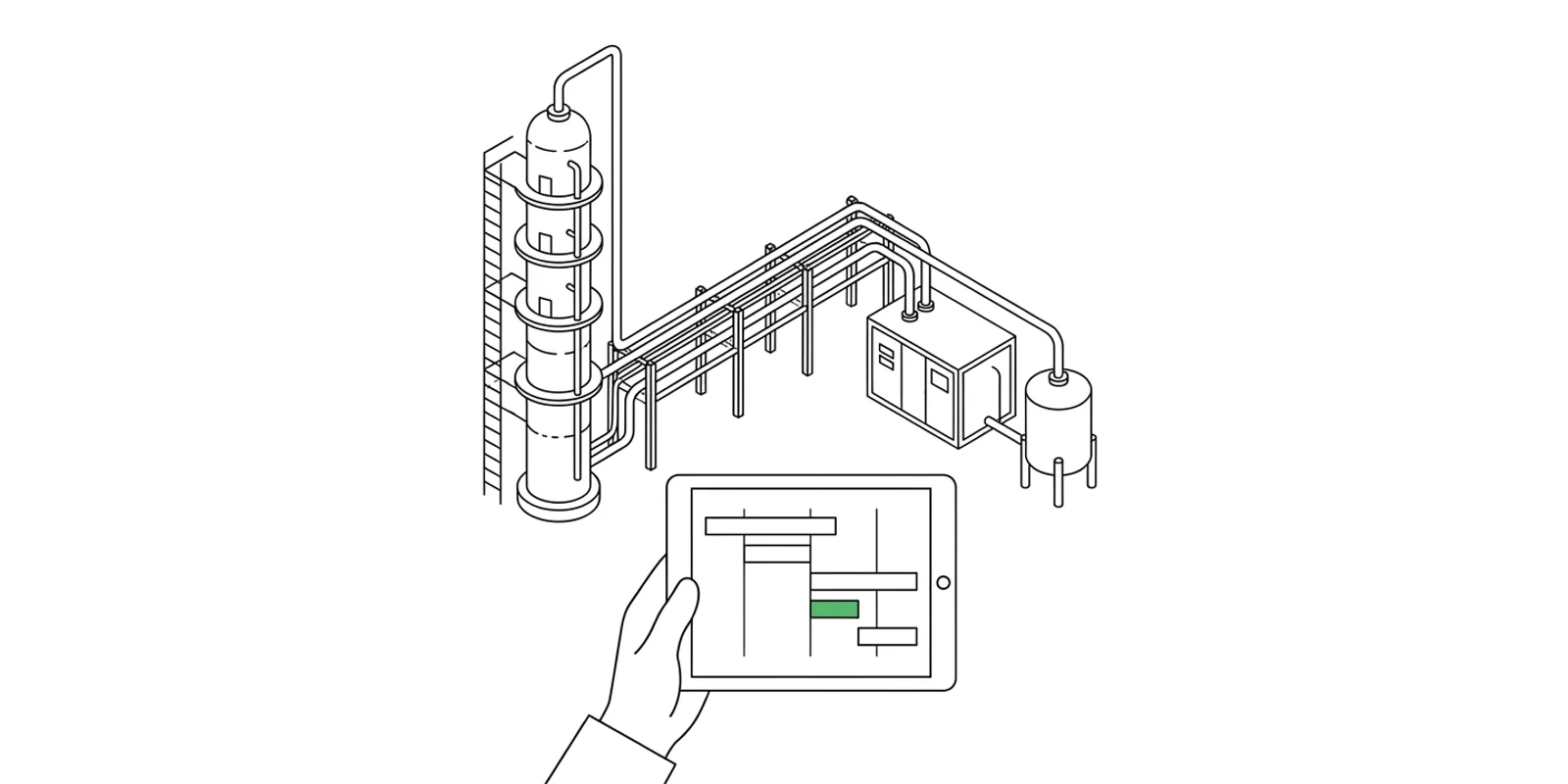
The update cycle, on any of these schedules
Whatever the industry, a schedule update records progress to a data date, revises the forecast of the remaining work and recalculates the dates that follow. Pathizer organizes that work as five steps, the same every period.
- Capture: the field team enters progress in the Schedule Updater by the period's due date and sends the final update to the scheduler as an .XER file.
- Add Fragnets: the scheduler adds the period's time impacts, such as a late delivery, a held permit or a change order, as fragnets under a Time Impact WBS.
- Health Check: the revised file gets the full Health Score, with its DCMA 14-point checks, as the would-be next update, before it is published.
- Review Meeting: the team goes over the impacts and the float paths together.
- Publish: the checked file is published to the project, the analysis runs, and the next period opens.
What the record builds
Each published update is kept beside the ones before it, one active update per data date. Over the life of the job that becomes the record delay analysis reads: Delay Analyzer traces the driving path to each phase milestone you name across the full update history, and Half-Step Adjustment Search keeps the progress apart from the revisions in each window. On an industrial job the milestones worth naming are rarely only final completion. They are mechanical completion, first power, ready for startup, first product or delivery of a hull, each with its own path.
Energy and utilities
Generation, transmission, substation, solar, wind, storage and nuclear work share two things: much of it happens next to or inside an operating system, and the date that matters is usually set by someone other than the builder. A plant outage is scheduled tightly, often by the shift, because every day the unit is offline costs the owner generation. A new plant or a renewables site waits on its interconnection to the grid and on the utility or transmission operator who controls it. Transformers, breakers and other high-voltage equipment can carry long lead times and sit on the critical path.
Nuclear work adds quality assurance requirements, such as the criteria in 10 CFR Part 50 Appendix B for safety-related work, which bring inspection and documentation steps into the schedule's logic. When one of those steps grows between updates, the narrative should say which one and why.
In the update cycle, interconnection and equipment dates belong in Add Fragnets when they move: a dated fragnet with the letter or purchase order revision that moved it, rather than an edited constraint nobody can trace. The Review Meeting is where an outage team decides what the next shift protects.
Oil, gas and petrochemical
Refinery and chemical plant turnarounds are scheduled in fine detail: many short activities, often planned to the hour, with the critical path running through the units that take longest to open, inspect, repair and close. Scope found after a vessel is opened is the usual cause of growth, and it has to be added as new work the day it is found.
LNG trains and other large process plants are often built from modules fabricated in a yard, shipped and set on site, then joined by piping and electrical work, taken to mechanical completion, commissioned and started up. Delays come from module fabrication and shipping, from late engineering and vendor data, and from systems turned over to commissioning out of order. Pipelines add right of way, permits and seasonal construction windows.
Discovered work is exactly what Add Fragnets is for. Each item goes in as its own fragnet, so Added Activities / Fragnets lists it with the period it arrived in, and Delay Analyzer can later attribute the days it pushed onto the path to that added work.
Advanced manufacturing: fabs, battery plants and pharmaceutical plants
A semiconductor fab is a building around a process. The cleanroom has to be built and certified before production tools can be set, and the tools need ultrapure water, process gases, chemical distribution and exhaust that are often still being commissioned when they arrive. Tool move-in, hook-up and qualification run in a sequence the owner's production plan depends on, so the milestone that matters is when each tool set is ready, not when the building is done.
Battery cell and EV plants follow a similar pattern, with process equipment installed in a finished building and parts of the line run in controlled environments such as dry rooms. Pharmaceutical and other life sciences plants add commissioning, qualification and validation before the plant can make product for sale. FDA guidance on process validation counts qualification of the facility, utilities and equipment as part of that work, and its documents take real time in the schedule.
Here the Health Check earns its place. A schedule that holds a production date by shortening qualification or tool install durations will show it as revised durations on the driving path, and the Review Meeting can ask about them before the update is published.
Heavy industrial and shipbuilding
Steel, metals, pulp and paper, and other heavy industrial plants share the process plant pattern: heavy foundations, large equipment with long lead times, a dense run of mechanical, piping and electrical work, then commissioning. Expansions inside an operating plant add tie-ins and shutdowns the operator has to grant.
A ship is built in blocks or modules, which are fabricated, outfitted, joined on the building way or in the dock, and outfitted further after launch, ending in tests at the pier, sea trials and delivery. Material and equipment deliveries, rework found at inspection, and design changes during construction are common causes of slip, and a delay to one hull can push the next one through the same dock. Where the yard keeps its schedule as an .XER or .XML file, each hull's delivery can be a milestone of its own in Delay Analyzer.
Mining
Mine development and processing plant projects are often remote. Access, camp capacity, logistics and seasonal weather shape the schedule as much as the work does, and permits and approvals can hold whole areas. The processing plant follows the process plant pattern, ending in commissioning and a ramp-up to production that the owner's plan depends on.
Weather Days keeps a ledger, from the first data date, of the days that met its fixed rules for rain, snow, cold, wind and thunder at the station of record, so a weather claim in the Review Meeting rests on the same days every month.
Infrastructure and transportation
Highways, bridges, rail, transit and airports are built around access the operator grants: lane and track closures, possessions and runway shutdowns, each with a window that cannot simply move. Utility relocations, right of way and permits are frequent causes of delay. The project type pages for highways and bridges, transit and rail, and aviation cover each one in detail.
Water and wastewater
A treatment plant usually has to keep treating while it is rebuilt, so the schedule is a sequence of shutdowns, bypasses and units returned to service one at a time. The water and wastewater page covers it in detail.
Government and defense
Public owners write their schedule requirements into the contract. The Federal Acquisition Regulation's clause on schedules for construction contracts has the contractor submit a progress schedule for approval and, when the work falls behind, lets the contracting officer require supplementary schedules showing how the approved rate of progress will be regained, and many agencies go further, specifying a CPM network, an update interval and a narrative with each update. U.S. Army Corps of Engineers contracts commonly call for the schedule in SDEF, which Pathizer reads alongside .XER and .XML files.
For the reviewer on the owner's side, the cycle is the same in reverse: each contractor update is compared with the prior one, and every finding traces back to the file the contractor submitted.
Commercial and institutional
Data centers, hospitals, laboratories and campuses are buildings, but the date that matters is often operational: a hall energized for IT load, a department open to patients, a lab ready for its equipment. Long-lead electrical and mechanical gear, commissioning and work next to occupied space drive most of the movement. The data center and hospital pages cover them in detail.
What Pathizer does with these schedules
The analysis works on the schedule rather than the industry. Pathizer reads .XER and .XML schedule files, Microsoft Project XML and SDEF, and compares each update with the one before it. Added Activities / Fragnets lists every activity inserted between updates, Half-Step Adjustment Search separates progress from revisions, and the Health Score runs the DCMA 14-point checks on every update. The 6WLA Plan lists the next priority activities from the analyzed network for the field, Risk Register (QAQC) derives active risks from the schedule itself, and Monte Carlo runs a risk simulation over the activity network beside the deterministic forecast.
Delay Analyzer then reads the whole history: the driving path into each phase milestone, update by update, with the days the record cannot support left unattributed.
Related pages
Other project types
Sources
Try it on your own files
Open your latest schedule update. Add last month's to see what changed. The free tools need no account. They are a screening, a first look before a full review.